
Museum Project Day – Tate Modern: Gathering Ground
Written by Thuy Pham, Head of Department of Education and Community, Vietnam National Museum of History (Vietnam, ITP 2025), Perihan Dönertaş, Archaeologist, Ministry of Culture and Tourism (Turkiye, ITP 2025), La’akea Ai, Digital Humanities Specialist, Bishop Museum (Hawai’i USA, ITP 2025), and Nabhan Al Barwani, Head of Collections, Oman Across Ages Museum (Oman, ITP 2025)
Exploring contemporary art is a great way to enrich your visit to London, especially at the iconic Tate Modern known worldwide as one of the top places for modern and contemporary art. This year, Tate Modern presents Gathering Ground, an exhibition that invites visitors to reflect on our relationship with land, community, and identity, as well as the larger impacts of climate emergency, social justice, and sustainability through the work of artists from around the world.
As part of the International Training Programme, which helps us develop important skills like teamwork, critical thinking, creativity, and cultural awareness, our team – Thuy Pham, Perihan Dönertaş, La’akea Ai, and Nabhan Al Barwani – was selected to visit Tate Modern and explore the exhibition Gathering Ground. This visit helped us better understand how artists think and use materials, as well as the concept of contemporary art.
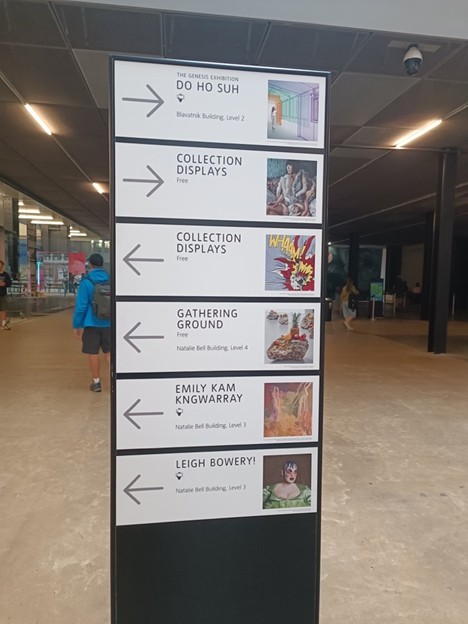
On the morning of 19 July 2025, we arrived at Tate Modern right when the museum opened. Even though it was raining heavily, there was already a long line of people waiting to get in. It was a beautiful moment – how art can still bring people together, no matter the weather. Inside, the atmosphere was calm and thoughtful. Near the information desk on the ground floor, visitors will find a directional panel showing all the exhibition routes to help navigate the museum. The panel includes thumbnail images that provide a visual hint of what to expect, making it easier for us to find our way to the Gathering Ground exhibition, which is located in the Natalie Bell Building on level 4 and has free entrance.
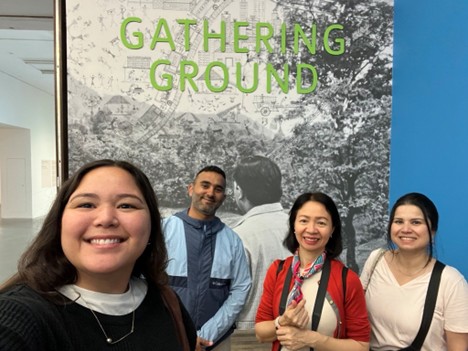
At the entrance of the exhibition, there were black-and-white wall graphics featuring one of the artworks with the title in green – a colour that symbolizes renewal and nature. The exhibition was divided into six studio spaces, each with different artworks and themes. The featured artists include Outi Pieski, Abbas Akhavan, Bruce Conner, Zheng Bo, Gauri Gill & Rajesh Vangad, Edgar Calel, Carolina Caycedo, and a new commission by Abbas Zahedi. Our thoughts on shared themes throughout the exhibit are in detail below:
Social Justice
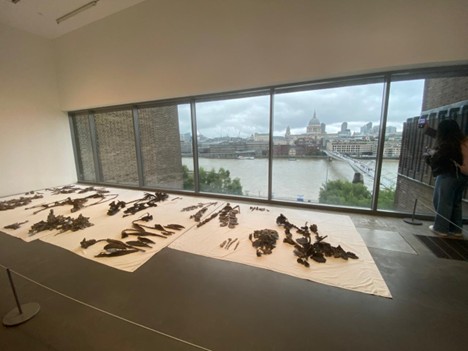
There were two studios with floor to ceiling windows overlooking the Thames river and into the City of London. Forcing the audience to look beyond the artwork and into the hustle and bustle of a city scape of crossing tour boats and crowds of people walking the Millennium bridge. In the forefront, laid across a white cloth were life-size, bronze-cast plants, native to Mesopotamia. The plants were displayed on the floor, isolated from one another, in a mass burial type of manner and reflects the loss of ecology due to decades of war. It gave me an eerie feeling and forced a sadness in me that I might have when mourning the loss of people. The body of work was presented by artist Abbas Akhavan and the duality of the display of death within the museum combined with the lively city behind, made a nice recipe for self-reflection and the role that museums can play in social justice.
As you leave the studio, you are guided into a dark room showcasing a slow-motion, black and white film, Crossroads, by Bruce Conner. The film replays 15 different clips of the underwater nuclear bomb tests on Bikini Atoll, Marshall Islands on July 25, 1946 committed by the United States. The ecological damage to both land and people were/are devastating and irreversible. Although I learned of this incident in school as a child, I cried thinking about my island home.
It is easy to forget, be naïve to, or not know of the atrocities and erasures of the natural landscape caused by humans. And it is important to acknowledge that this landscape was different before us, it was a different kind of lively. In ʻōlelo Hawaiʻi (Native Hawaiian language), there is a proverb that says “he aliʻi ka ʻāina, he kauwā ke kānaka”, which translates to – the land is king and the people are its servants. I believe that Gathering Ground echoes those words in forcing the audience to think about their past, present, and future relationships with the natural world around them and to remind them that the earth precedes man. La’akea Ai
Climate Change – a human crisis
Study for a Monument by Abbas Akhavan displays bronze casts of endangered plants, placed on white sheets like war casualties. This work made me realize that losing nature means losing part of ourselves. Can we stop trying to control nature? Can we learn to live more in harmony?
Tate Modern’s Gathering Ground made me believe that museums are not just places to keep art but can also be spaces for care, dialogue, and action. Using energy-saving lights, eco-friendly materials, and recyclable labels shows that museums can really act. Sometimes, when talking about the climate crisis, exhibitions don’t need lots of information but need to connect people with nature – not just to share knowledge but to touch hearts. That is the start of real change. Thuy Pham
Sustainability
As you enter the exhibition hall, the sounds and frequencies that greet you offer not only a visual but also an auditory and emotional experience. These sounds expand the viewer’s perception, allowing for a deeper connection with the space and the works.
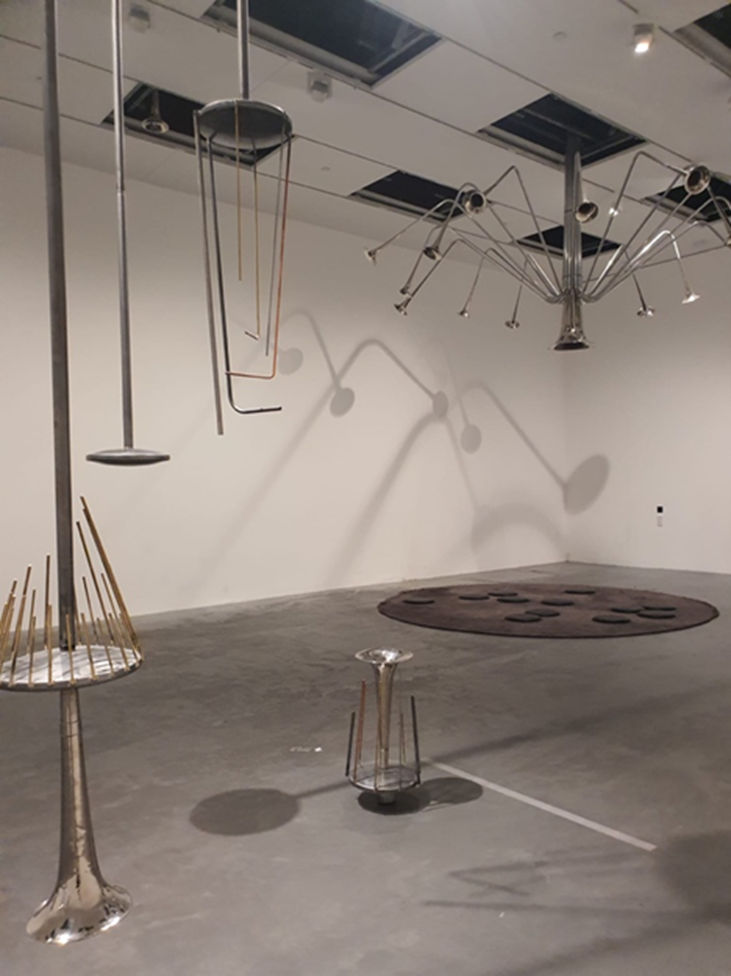
Abbas Zahedi’s installation Begin Again consists of minimalist objects created from recycled materials. Designs reminiscent of plumbing pipes and a wind instrument, the trumpet, captivates the viewer both visually and aurally. The connection of these pipes to the building framework, and the sounds emanating from them, evoke the feeling that the structure is speaking to itself. This installation invites the viewer to an experience of inner cleansing and collective well-being.
Edgar Calel’s installation, Sacrifices to the Gods, represents gratitude to nature and its generosity. The presentation of fruits and vegetables on natural stone highlights nature’s abundance and cyclicity. At the end of the exhibition, the transformation of these fruits and vegetables into natural fertilizer demonstrates how art and the cycle of nature can be integrated.
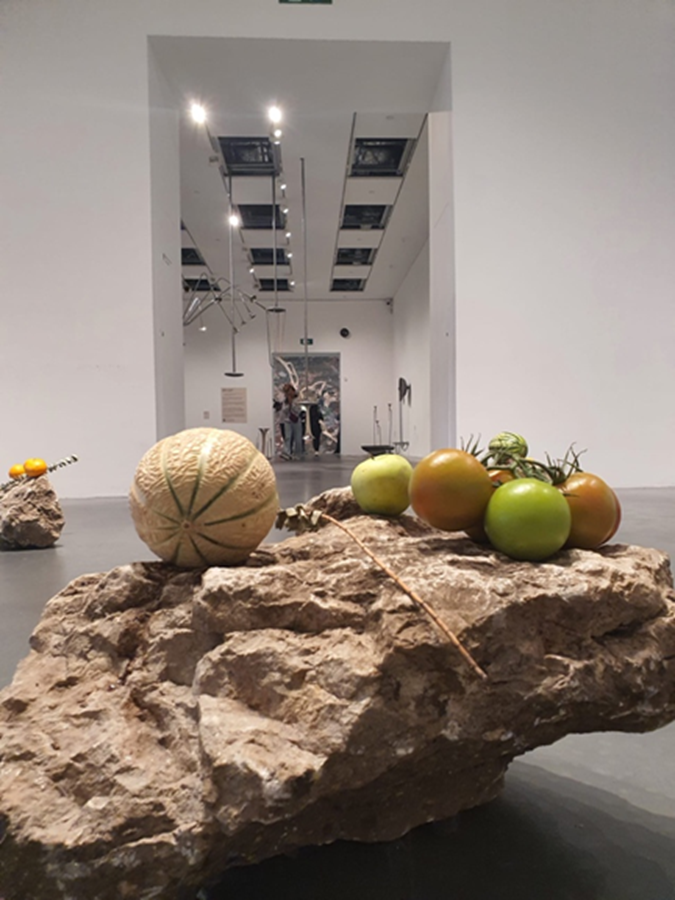
Tate Modern implements sustainability not only through its exhibition content but also through its practices: it uses 100% renewable energy, it reduces water consumption with rainwater harvesting systems, opts for low-energy lighting systems, uses recyclable and PVC-free materials for exhibition texts and prints, permanent fixtures (carpet, furniture, sound panels) are integrated into the exhibition for reuse. This holistic approach demonstrates that the museum views sustainability not only as a thematic issue but also as a practical responsibility.
Gathering Ground is a powerful example of how museums can actively address social and ecological issues. By harnessing the transformative power of art, it invites visitors not only to observe but also to think, feel, and act. The most important message I took from this experience was this:
“A sustainable future is not just an environmental issue; it is also a cultural, emotional, and collective issue. And museums can be at the very heart of this transformation.” Perihan Dönertaş
We were happy for the opportunity to visit a new place together – to learn from a new museum, a new exhibit, and ultimately to learn from each other. However, we did think there were a few things that could have made the display better. We thought that the text itself wasn’t written in a voice that was inclusive to all ages or levels of English and there could have been better crowd control in specific rooms of film screenings where unchaperoned younger audiences would linger and be disruptive. On a positive note, we all agreed that we enjoyed the use of mixed media (film, sound, wall-art, and 3-D art); we thought it was well organized and had a good flow. We especially liked that labels included QR codes for folks to learn more and gave information on upcoming artist lead support groups to start/continue conversations around protecting and preserving the natural world. It was a step further from what the exhibit already questioned and offered its audience.
In conclusion, we believe that the Tate Modern produced an impactful, emotional, and thought-provoking display that encouraged us to reflect on our own positionality in the larger context of global issues that affect us all.