Museum Project Day – The Design Museum: More Than Human
Written by Julián Roa Triana, Freelance Museum Consultant (Colombia, ITP 2025) Li Yingchong, Section Chief of Educational Research and Development, The Palace Museum (China, ITP 2025) Safoura Kalantari, Cultural Heritage Expert, The Organisation of Cultural Heritage, Tourism and Handicrafts of Sistan and Baluchistan Province (Iran, ITP 2025) and Komal Pande, India, Deputy Curator, MAP Bangalore (ITP 2025)
Life, practice, and design are the three cardinal points of living beings, not only of humans but of all living organisms and forms. The sophistication of our lives as individuals, and of culture as a collective, rests upon a perfectly harmonious blend of these three elements. The ongoing temporary exhibition at the Design Museum, Kensington, London, was both an inspiration and a space for addressing the objective beauty in design rather than its decorative formal opulence.
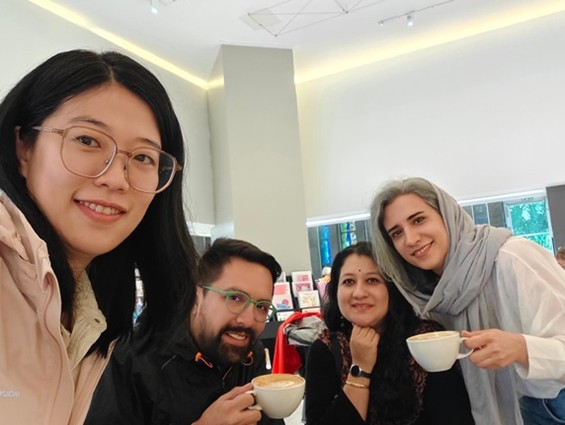
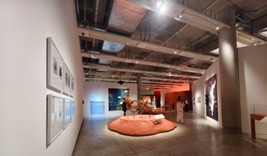
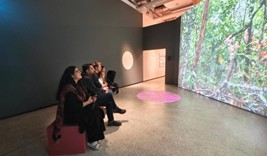
A group of ITP Fellows 2025, including an interesting mix of a Museum Thinker (Julián Roa Triana – Colombia), a Museum Educator (Li Yingchong – China), and Museum Curators (Safoura Kalantari and Komal Pande – Iran and India), were assigned to visit the Design Museum to explore and reflect on the ongoing exhibition More than Human. On a beautiful rainy Saturday morning, we departed from Schafer House on a double-decker bus, enjoying the city view along the way. This blog includes our curatorial discourse, the questions we posed in the exhibition space, and the discussion we had at the conclusion of our visit.

Who is the wisest of all?
The first thing that grabs your attention is the title: More Than Human. It quietly challenges a belief so deeply rooted in us – that humans are the centre, and the world should revolve around our needs.
As we moved through the exhibition, one question kept echoing in our minds: who is truly the wisest? Us, with all our intelligence and inventions? Or the seemingly simple beings – like insects, birds, or fungi – who manage to meet their needs without harming others?
One of the most powerful aspects of the exhibition was being invited to see the world through non-human eyes: to hear the voice of a river, to consider designing a cosy chair for insects, or to imagine a house where humans, bugs, and even fungi could coexist.
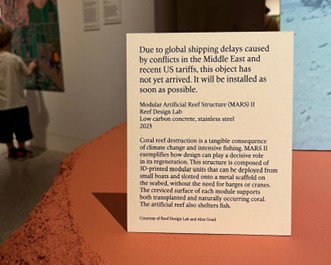
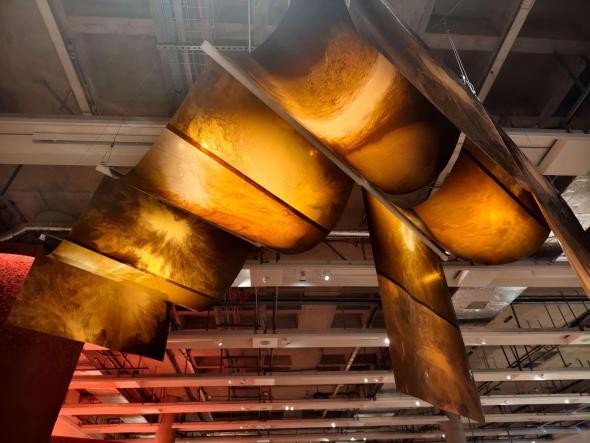
We wandered through The Council of Kelp, picturing how they might respond to today’s urgent problems. It was a beautiful exercise in empathy – beyond our species. And yet, even in this attempt to decentre the human, reality intruded: some objects meant for display never arrived in London, delayed by issues caused by humans themselves. So, back to the question: who is the wisest? We humans have had our time. The results of our decisions are all around us.
Who defines wisdom in design?
The More Than Human exhibition poses this question softly, yet persistently. Its title alone challenges the long-held notion that humans are the sole measure of intelligence, urging us to look beyond our own needs.
As you move through the space, the tension between human-centric design and nature’s quiet wisdom becomes clear. Take The Council of Kelp – it is more than an artwork; it reminds us how seaweed has sustained marine ecosystems for millennia, adapting and thriving without fanfare. This prompts a question: is wisdom found in grand inventions, or in the ability to coexist harmlessly?
More Than Human doesn’t offer answers. Instead, it points to a simpler idea: wisdom lies less in “solving” nature than in conversing with it. It pushes us to rethink our relationship with nature, shifting from exploitation to collaboration.
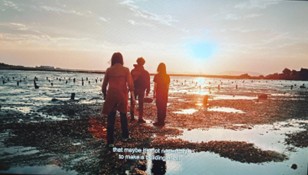
Consider DnA_Design and Architecture’s 2022 project Into the Island, on Fujian’s Meizhou Island. Invited to design a museum, they took an unconventional approach: rather than building a traditional structure, they proposed site-specific interventions across six locations, repurposing existing materials and structures. This exemplifies “more than human” design, prioritising ecosystem health and species regeneration over human-made structures alone.
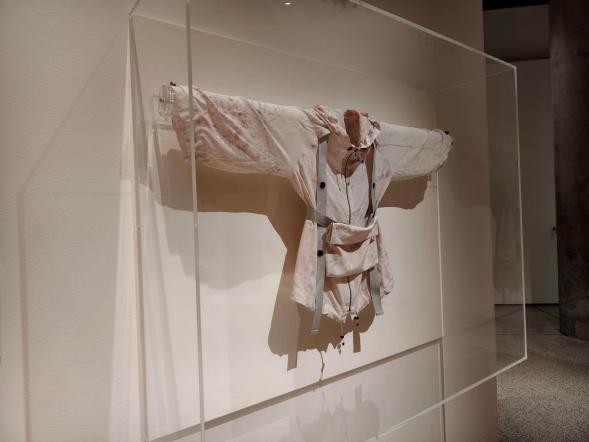
Similar to Faber Futures’ NPOL Original: Exploring Jacket and Musette Bag and Jessie French’s 1708 – Sands of Time, 1707 – Red Flag, Into the Island reimagines design’s role. It is not about adding more buildings, but working with what already exists – recycled pillars for oyster cultivation, the tides, and the fishermen’s routines.
In these efforts, science provides understanding (e.g. how tides function, how bacteria dye silk); new ideas fuel the courage to break norms (like questioning endless construction); and design weaves these into actions that reconnect us. Here, design is not about dominance. It is about remembering that we’re all in this together. And that may be the wisest thing of all.
What would it be like to take a holiday from being human?
To gain the ability to detach oneself from the simplest and most complex human passions – to shed the body in order to forget our devastating logics of consumption and our capacity to transmit memory through the technologies we have created for hundreds of thousands of years.
Thomas Thwaites proposes, with his work A Holiday from Being Human (GoatMan) (2016), a pause in the frenetic adventure of being human: to step into the shoes – or rather, the hooves – of a Swiss goat. To be like it: to graze and climb the Alpine mountains in order to reach the most extreme form of otherness, understanding a creature with whom we coexist, and whom we have domesticated to exploit in the supposed race for the survival of the fittest.
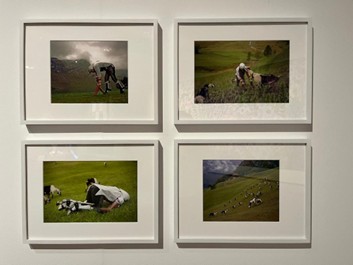
That perverse logic behind the struggle is what leads Thwaites to propose a halt, and through a performative act, to consider the possibility of becoming “the other animal”. The work fails completely in its goal of taking a holiday from the exhausting task of being human, and instead reveals the impossibility of understanding the logic, or better, the path, of animal life.
This attempt can be seen in a series of photographs where, with a certain curiosity, the goats do not recognise the artist as one of their own, turning the performance into a comical scene about the idea of trying to be More than Human – an attempt that ends in abrupt failure. Wanting to be and think like “the other” is a difficult journey. The shaman, with ancestral knowledge passed down through generations, consumes the substances the planet offers in order to become the spirit of a jaguar, a tapir, or an eagle. In this way, some have spent thousands of years becoming other animals – something many of us have forgotten.
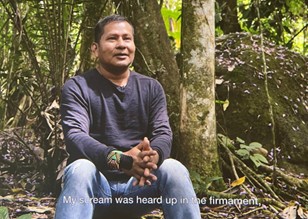
To live better in this common home, as this exhibition proposes, we are left only with the possibility of recovering our spirit and once again flowing toward the being of ‘the other’, so that we may learn from them.
Curator v/s Designer Dialogue?
Interestingly, we had a ‘necessary’ curator vs designer dialogue! We approached the layout of the exhibition rather critically and debated how indigenous knowledge systems should be represented in a white cube exhibition space vis-à-vis the idea of design. Should they be treated as a mere prelude to contemporary institutional design innovations, or should they be positioned at the centre as the climax of the origins and continuity of design? We also reflected upon the entry and exit points of the layout and the need for a circular or loop movement in such displays – ones that present a more holistic idea of design, rather than a linear chronological order.
After viewing the exhibition, we visited the museum shop, and – over a cup of coffee – we had a humorous human conversation about how contemporary design nowadays is pricier… for humans!