
Museum Project Day – The V&A: Design and Disability
Written by Demetra Ignatiou, Independent Museologist / Associate Curator, Bank of Cyprus Cultural Foundation (Cyprus, ITP 2025) Fernando Astudillo, Associate Professor of Anthropology, Universidad San Francisco de Quito (Ecuador, ITP 2025) Gehad Ali, Community Engagement and Outreach Programme Coordinator, The Archaeological Awareness Administration of Luxor (Egypt, ITP 2025) and Deemanka Jayakodi, Curator, Colombo National Museum (Sri Lanka, ITP 2025)
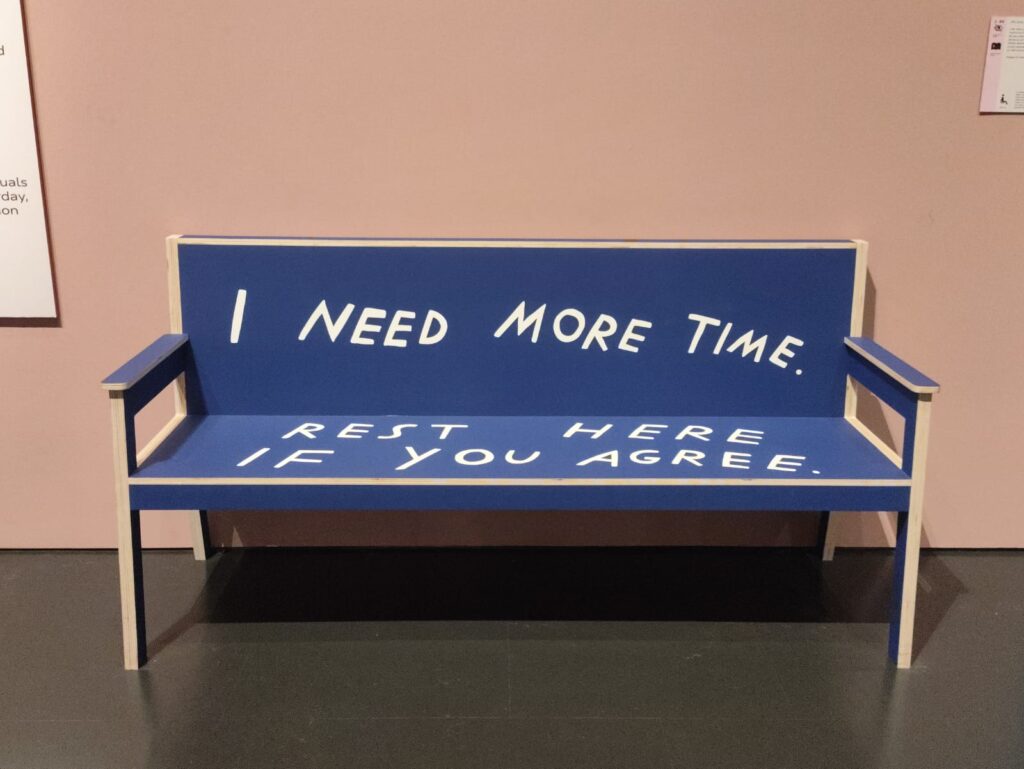
This message written in big white capital letters on the surface of a blue bench, by Finnegan Shannon, greets visitors entering the exhibition, giving us a glance to the curatorial and exhibition design approach.
Design and Disability, currently on view at the Victoria & Albert museum, is a temporary exhibition centered around the (often disregarded) capacity of design to address structural inequalities in the ways that disabled people experience this world. It showcases how design can promote and create accessibility and inclusiveness when informed or driven by the experiences of people and communities with disabilities and how it can also find applications in activism and claimings of visibility, equality and justice. Structured in three main exhibits: Visibility, Tools and Living, the exhibition highlights the agency of disabled individuals and initiatives by several groups of disabled, by introducing their voices and showcasing not just objects and concepts designed for them but also by them.
The exhibition carries powerful messages that can be summarized in four topics:
- Challenging pity – encouraging people to stop feeling sorry for individuals with disabilities.
- Solidarity and participation – emphasizing the role of people with disabilities in the community and promoting their inclusion.
- Inspiration for all – sharing powerful stories of individuals who overcame barriers and obstacles to achieve their dreams, inspiring both disabled and non-disabled audiences.
- Power of technological innovation – employing technology to reimagine and redevelop material culture, empowering disabled people.
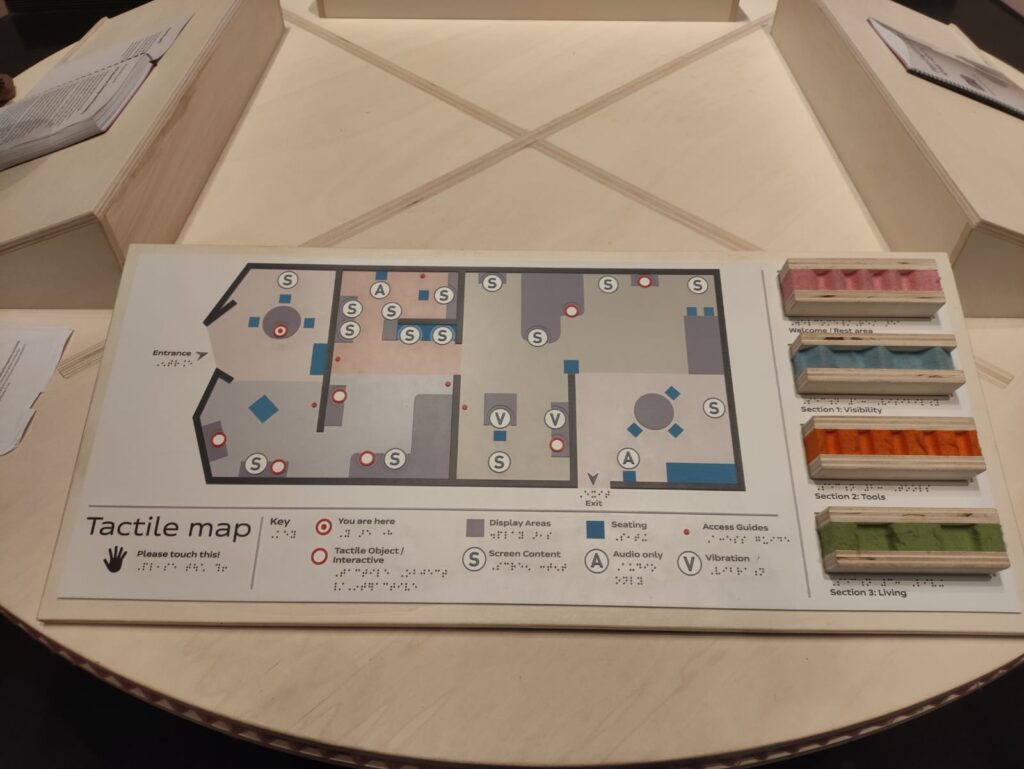
The welcome-rest area and the three main exhibition sections are marked by the use of different colours on the walls and display different aspects of design. As the visitor enters the pastel pink welcome-rest area it becomes evident that the exhibition aspires to provide opportunities for engagement to all, a general public of disabled and non-disabled visitors, of a broad age span. Emphasis is placed on the aspect of accessibility with a tactile and a sensory map of the show installed right at the entrance of the exhibition space alongside an introductory video in the British Sign Language (BSL), various copies of “Plain English Guides” focusing on 10 Key Objects and “Large Print Guides”, access guides with audio description and BSL interpretation available through QR codes to be used throughout the exhibition.
The “Visibility” section reflects on the struggles and resistance of people with disabilities, starting from early protest movements to assert their presence in different parts of the world. This section “explores approaches to design developed within Disabled, Deaf and Neurodivergent communities” and incorporates their stories and lived experiences. Throughout this section, it becomes evident how design activism can address structural inequalities and create new opportunities.
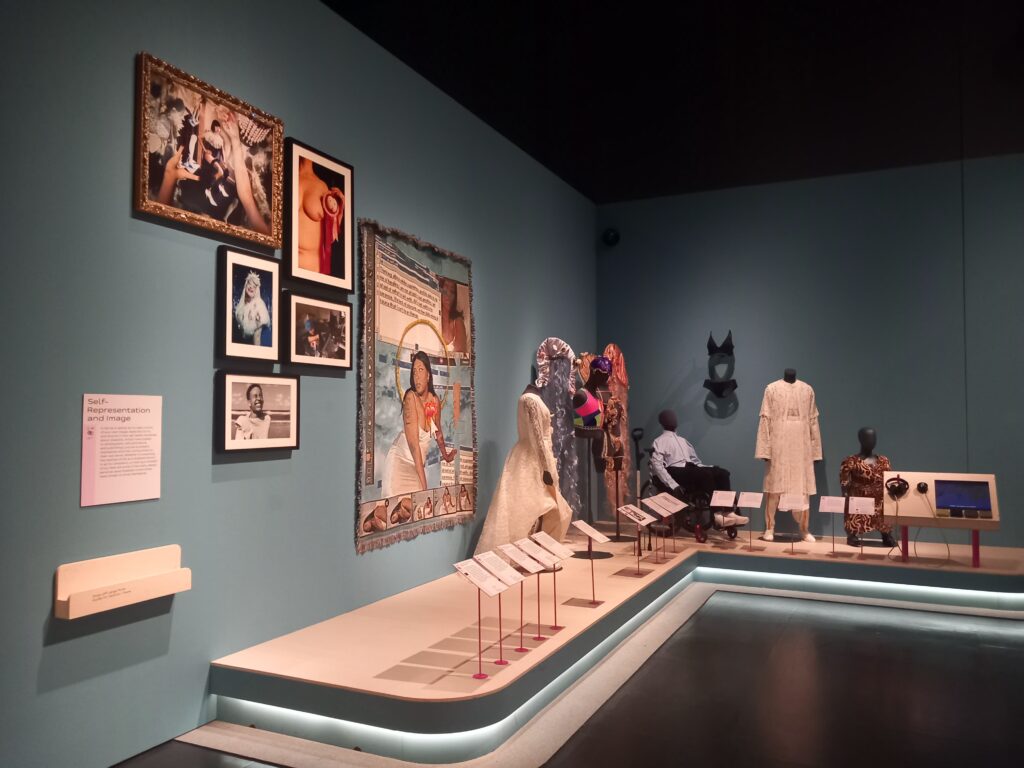
The second section titled “Tools” highlights the importance of thoughtful consideration when designing tools, and emphasizes the role of people with disabilities as active participants in the design process. It challenges the stereotypical view of disabled individuals as merely passive recipients of design concepts, instead presenting them as active contributors and co-creators.
The final section, “Independent Living”, delivers a message that should be acknowledged and acted upon: the fundamental right of people with disabilities to be considered in urban planning and be visible in all aspects of daily and social life. The exhibits demonstrate how different individuals could and should be able to experience the world in their own terms.
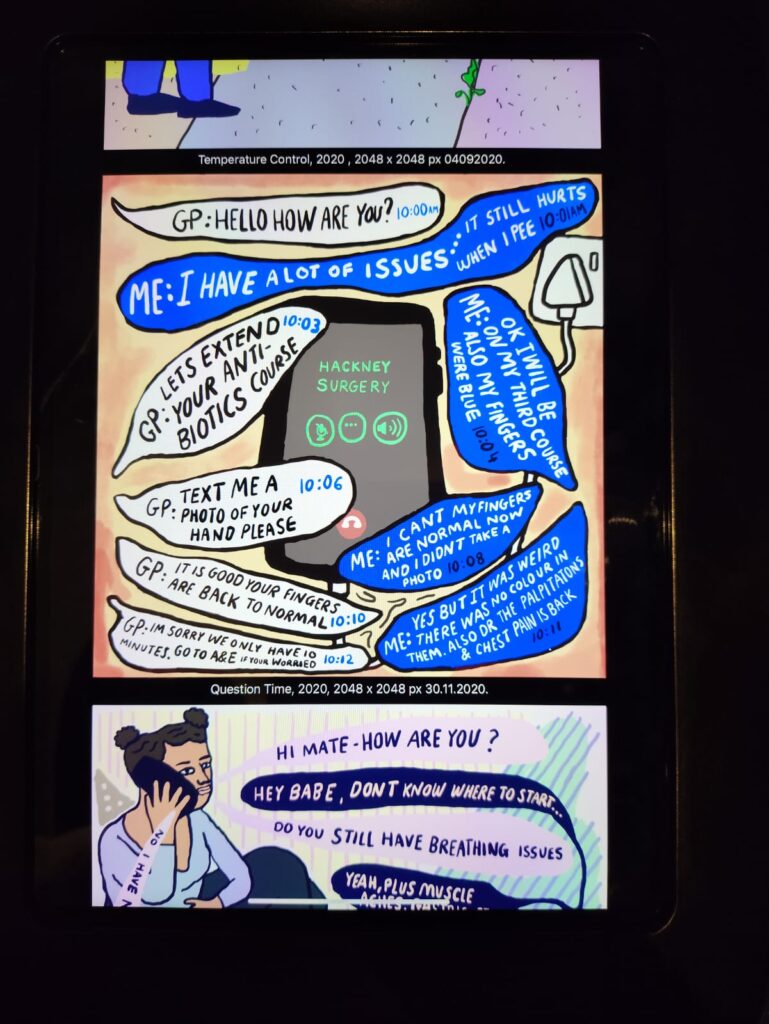
There is an attempt to make the exhibition space welcoming and accessible to as many people as possible and the language used is clear and comprehensible. Interactive technologies are included in the forms of video games as well as tactile exhibits and audiovisual installations. However, in some cases, as visitors we felt overwhelmed by the number of objects on display in each section. There are numerous labels and panels throughout the exhibition, which create confusion and distract attention from the actual objects. Additionally, each main theme includes multiple sub-topics, which contributes to the overall complexity. It would be more effective to select one or two subtopics and present them in greater detail rather than using a broad and scattered approach. Sometimes objects are displayed high upon the surface of the wall which might make it challenging for individuals with a disability to access them. Finally, we believe that more opportunities to engage with some of the objects, such as the video game controller, personal grooming items, and experience their use and activation instead of just seeing them on display would make up for a more engaging experience.
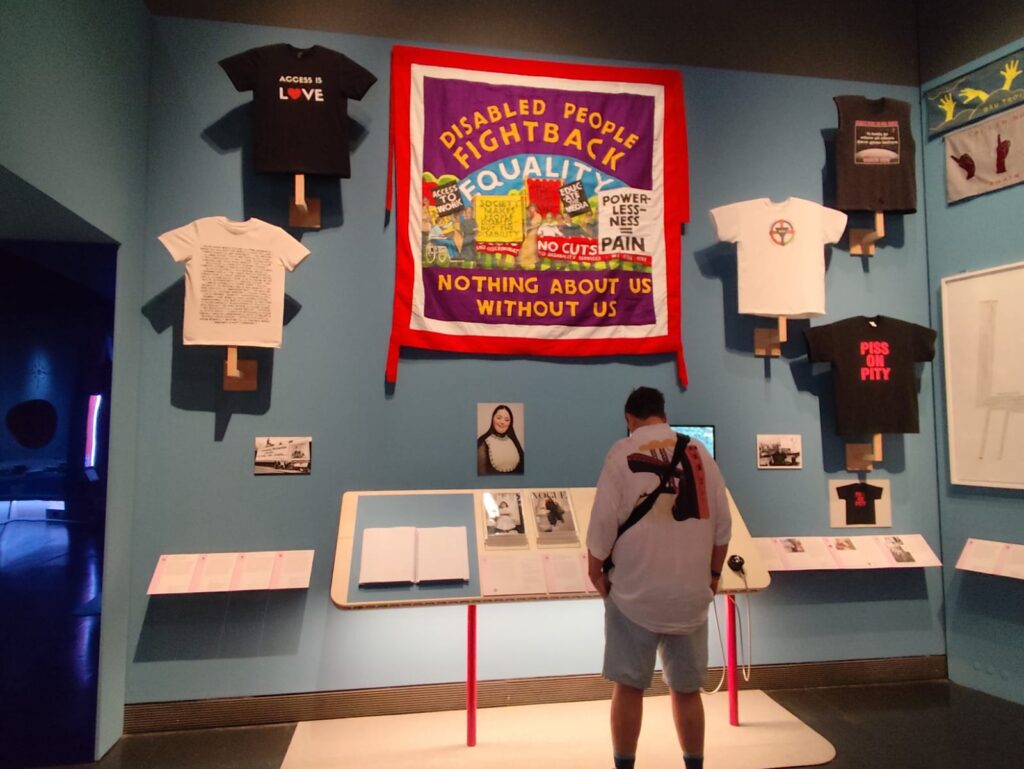
Overall Design and Disability acknowledges the complexity and multiplicity of disability and the social conditioning factors that shape our prescriptions of disability, inviting the visitors to revisit such perceptions inside and outside the gallery space by introducing concepts such as crip time, debility and ableism. This is perhaps the greatest and most topical achievement of this show.