
Behind the scenes: The Manila Galleon Exhibition travels to Colegio de San Ildefonso, Mexico City
Written by Aprille P. Tijam, Associate Director and Head of Exhibitions and Collections, Ayala Museum (Philippines, ITP 2019)
In late October 2025, I had the opportunity to travel to Mexico City as the project lead and one of the couriers of the Philippine loans forming part of the exhibition Somos Pacifico: The Acapulco-Manila Galleon exhibition at the Antiguo Colegio de San Ildefonso, Mexico City. The exhibition opened to the public on December 4, 2025. I never imagined that, two years after its presentation at the Asian Civilisations Museum (ACM), Singapore, Manila Galleon: From Asia to the Americas would have a second iteration in Mexico, a connecting port of central significance to the Manila Galleon narrative. I shared the behind-the-scenes story of the exhibition preparations at the ACM in my blog, Behind the Scenes: Manila Galleon Exhibition at the Asian Civilisations Museum Singapore – ITP

Left: Pre-colonial gold objects from Ayala Museum and Vicky Amalingan-Sales collections and Likha from the Museo Enrique Zobel collection (object on right on pre-colonial gold showcase). Photo courtesy of Colegio de San Ildefonso.

Photo courtesy of Colegio de San Ildefonso
In late 2024, the Embassy of Mexico in the Philippines approached Ayala Museum to explore a possible collaboration on this exhibition. Once again, Ayala Museum served as the collecting agent, coordinating all Philippine loans and managing the preparations, working closely with both the Embassy of Mexico in the Philippines and the Colegio de San Ildefonso to bring the Philippine collection to Mexico. Ambassador Daniel Hernández Joseph notes: “The Embassy of Mexico is very appreciative of the collaboration provided by the Ayala Museum and the Ayala Foundation which materialized a most visible Filipino participation in the exhibit “Somos Pacífico” currently on show in Mexico City. It has made it possible to include, at the center of the narrative of the exhibit, a Filipino perspective on our shared History and the Manila-Acapulco Galleon’s contribution to trans-pacific relations.”
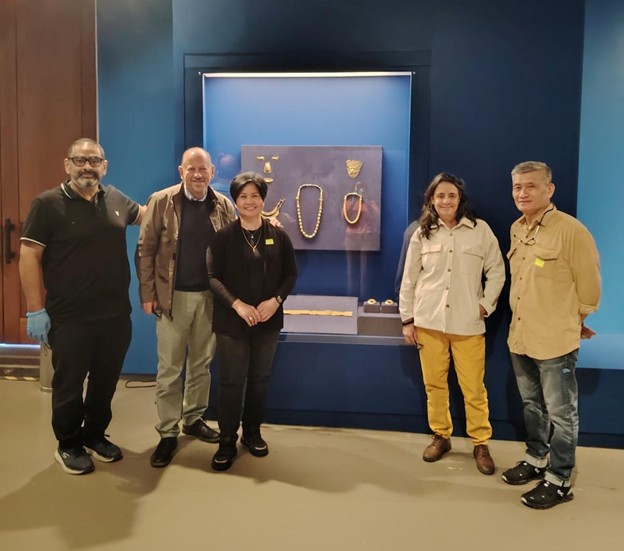
Left to right: Officers of the Colegio de San Ildefonso: Ernesto Bejarano Villegas (Exhibition Designer), Eduardo Vázquez Martín (Director), Aprille Tijam, Carmen Tostado (Exhibition Coordinator), and Kenneth Esguerra (Senior Consultant, Ayala Museum).
Somos Pacifico is an expanded and enriched iteration of the ACM’s Manila Galleon: From Asia to the Americas—curated by Clement Onn (Curator and ACM Director)—presented at the ACM from November 2023 to March 2024. The exhibition in Mexico is a curatorial collaboration of Onn with Dr. Iván Valdez-Bubnov (Institute of Historical Research, Universidad Nacional Autónoma de México–UNAM), Dr. Roberto Junco (Subdirectorate of Underwater Archaeology, National Institute of Anthropology and History–INAH, Mexico), and Shabbir Hussain Mustafa, Teo Hui Min, Cheng Jia Yun, and Seline Illana Teo (National Gallery Singapore), and the Colegio de San Ildefonso.

Pedro Murillo Velarde, S.J. (1696-1753). Engraved by Nicolas de la Cruz Bagay. CARTA HYDROGRAPHICA, Y CHOROGRAPHICA DELAS YSLAS FILIPINAS DEDICA AL REY NUESTRO SEÑOR, 1734. Fernando and Catherine Zobel de Ayala Collection. Photo courtesy of Colegio de San Ildefonso.
With more than 300 objects drawn from national and international collections in the Philippines, Singapore, and Mexico, the exhibition traces the cultural heritage connecting Mexico and the Philippines through the Manila Galleon maritime route, which crossed the Pacific Ocean for 250 years, from 1565 to 1815. Objects such as maps, paintings, prints, wooden chests, religious artefacts, ceramics, navigational instruments, and textiles weave an intercultural narrative between Acapulco and Manila that shaped the economic, social, and political dynamics of both places.

Aprille Tijam with Ernesto Villegas (Exhibition Designer, Colegio de San Ildefonso). Photo courtesy of Mariana Alejandra Aguilar Gutierrez, Colegio de San Ildefonso. Belt. 10th – 13th century. Gold. 374.5 grams. Vicky Amalingan-Sales Collection.
Included in this exhibition are more than 20 objects from the Philippines—majority were featured in the Manila Galleon exhibition at ACM. These works were loaned from the collections of Ayala Museum, Intramuros Administration, Museo Enrique Zóbel (Calatagan, Batangas), Richard and Sandra Lopez, Paulino and Hetty Que, Vicky Amalingan-Sales, Fernando and Catherine Zóbel de Ayala, and the Gilbert Zuellig Memorial Library, Manila. Together, these objects underscore Manila’s significant role in this global maritime trade and illustrate the cultural and historical connections between the two territories. I am grateful to ACM Director Clement for meeting with me online in the first quarter of 2025 and again at ACM Singapore in May 2025 to discuss the exhibition and the selection of objects, underscoring the significance of including cultural heritage materials from the Philippines.


(Artwork at left) Juan Luna, Woman with Manton de Manila, Ca. 1880s, Ayala Museum Collection, Gift of Mercedes Zobel McMicking. Photo on right courtesy of Colegio de San Ildefonso; photo on left by Aprille Tijam.


Fernando Zóbel de Ayala, Chairman of Ayala Foundation, emphasized that “the objects from the Philippines contribute to the dialogue posited by the exhibition’s curators, recognizing these as evidence of the historic relationship forged between the two countries during the Manila Galleon trade. They signify the interconnectedness formed through centuries of exchange—reflected in influences on food, language, clothing, crafts, designs, and many more elements that are evident throughout the exhibition.”

The exhibition design, conservation and art handling teams at the Colegio de San Ildefonso with Ayala Museum Representatives.

Ayala Museum donated a selection of books on exhibitions to the Colegio de San Ildefonso. Left to right – Aprille Tijam, Luis Arturo Marquina (Head, Conservation Department, Colegio de San Ildefonso), and Kenneth Esguerra.
Upon reaching the exhibition venue, the rich history of the Antiguo Colegio de San Ildefonso was quite a revelation. I was in awe of the magnificent building and the murals that adorned its walls. Founded and initially occupied by the Jesuits from 1588 to 1767, the building later served a variety of functions before housing the National Preparatory School of the National University of Mexico from 1867 to 1972. It was reopened as a museum in 1992, preserving its architectural grandeur and cultural significance. The building is also considered the birthplace of the Mexican muralism movement featuring works by Diego Rivera—whose first mural, La Creación (The Creation, 1922), can be found in the Simón Bolívar Amphitheater—alongside works by David Alfaro Siqueiros, José Clemente Orozco, and others.


Jose Clemente Orozco (1883-1949), LA LIBERTAD (1923-1924), Fresco, Colegio de San Ildefonso, Mexico City.


Diego Rivera, La Creacion (The Creation), 1922. Photo on right (left to right): Kenneth Esguerra, Veronica Herrea Rivera (Research), Aprille Tijam, Carmen Tostado, and Ernesto Bejarano Villegas. Behind is a mural by Jose Clemente Orozco.
And as part of my ongoing efforts to strengthen connections between our programs and diplomatic missions, we visited the Philippine Embassy in Mexico. During the visit, we introduced the Somos Pacifico exhibition and discussed potential collaborations with Ayala Museum and the Nayong Pilipino Foundation, where I have the privilege of serving on the Board of Trustees, exploring new opportunities to showcase Philippine heritage on the international stage.

Left to right: Aprille Tijam, H.E Ambassador Arvin de Leon (Philippine Embassy in Mexico), Marissa Winkler (Third Secretary and Vice Consul, Philippine Embassy in Mexico), and Kenneth Esguerra (Ayala Museum Senior Consultant) during the courtesy call at the Philippine Embassy in Mexico.
As project lead, I am honored and grateful to have worked closely with His Excellency Daniel Hernández Joseph (Ambassador) and Marcos Octavio Vara Jacobo (Cultural Attaché) of the Embassy of Mexico in the Philippines; Fernando Zóbel de Ayala (Chairman, Ayala Foundation); our counterparts at Colegio de San Ildefonso—Eduardo Vázquez Martín (Director), Carmen Tostado (Exhibition Coordinator), Oscar Mentojo Rizo (Legal and Administrative Coordinator), and Luis Arturo Marquina (Head of the Conservation Department); the Ayala Museum team—Jorell Legaspi (Senior Director, Arts and Culture), Kenneth Esguerra (Senior Consultant), Arnold Torrecampo (Senior Arts Handler), Jo Ann Gando (Senior Graphic Designer), Henrielle Omolida (Collections Associate Manager), Francesca Locsin (Exhibitions Associate), and Rex Reynaldo Cabugon (Multimedia Specialist); Tony Lambino (President, Ayala Foundation); the Ayala Foundation Administrative, Finance, and Governance offices; the office of Daniel Christian Zuellig; as well as Gino Borromeo (Strategic Communication, Ayala Corporation). I acknowledge the support of the team of Joelah Solis (Head, Permits and Licensing Section, Cultural Properties Regulation Division) of the National Commission for Culture and the Arts, under the auspices of Dr. Eric B. Zerrudo (then Executive Director, now Chairman), in processing the export documentation.
The Philippine participation was made possible through the collaboration of the Embassy of Mexico in the Philippines and the generosity of Ayala Corporation, Ayala Foundation, Inc., the Gilbert Zuellig Memorial Library, Manila, and the National Commission for Culture and the Arts.